“The truest form to who I am does not exist in the American / alphabet.”
– Amber McCrary

A person might wonder: how can we communicate with our elders? What happens to our love when we are separated by language? How do we then show care? Amber grapples with these questions and her connection to her own nálí and her father in poems pondering the Ł in Diné language.
On the right: Blue Corn Tongue: Poems in the Mouth of the Desert
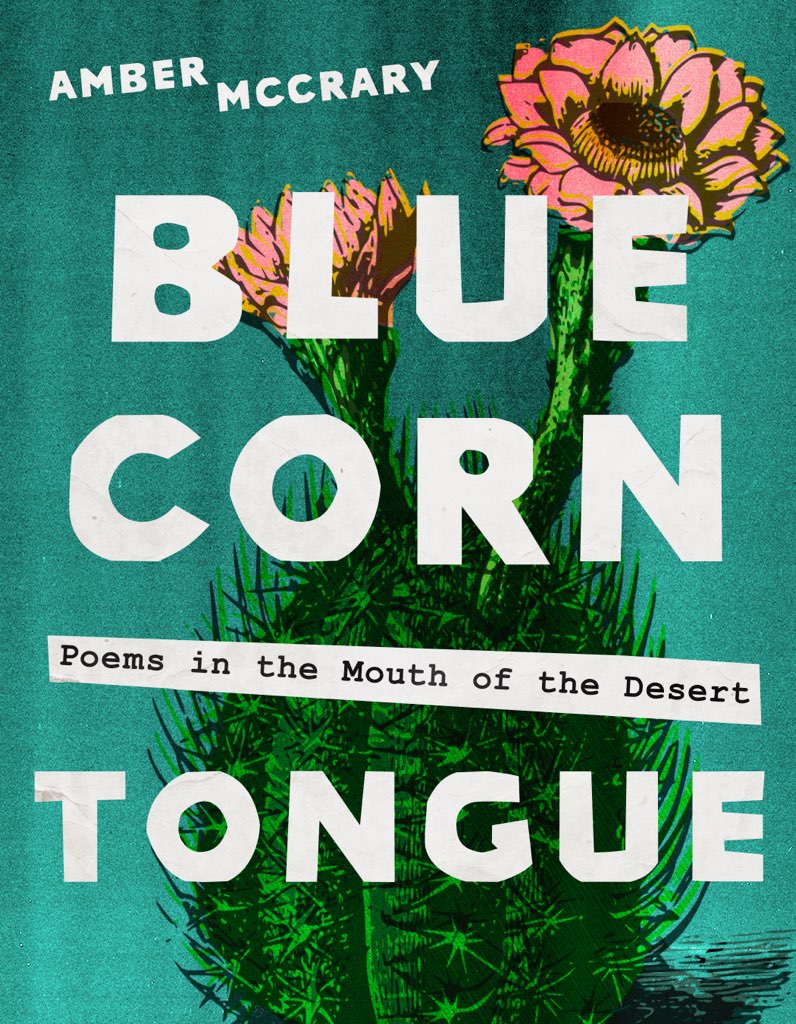
A Review of Amber McCrary’s Blue Corn Tongue: Poems in the Mouth of the Desert
by Manny Loley
Leading The Way Vol. 23 No. 6
Saad bee naa’ach’aah is a phrase I’ve heard Diné writers use to describe poetry. This phrase translates to “drawing or creating an image with words.” A simple internet search for poetry mentions, “a quality of beauty and intensity of emotion.” Diné language, prayers, and stories have always held poetic qualities. In our words, we recreate worlds and experiences in the tonal shifts and quality of sound in our speech. In our words, we recognize aspects of beauty and harmony that are central to our lifeways. In our words, we deal with multiple kinds of intensities—intensities of harmony, intensities of love, intensities of the spiritual, intensities of historical trauma, intensities of what it means to be human, and so much more. These elements of language and experience ties our contemporary expressions of story telling and poetry to the original narratives in hane’. The stories we tell today and the older stories we rely on for strength in our ceremonies share the same purpose—to help us live beautiful and meaningful lives. The first book in this series, Amber McCrary’s first full length poetry collection Blue Corn Tongue: Poems in the Mouth of the Desert represents a deeply felt and thoughtful “story of a girl who remembered the land” and who continues to question what it means to be a Diné Asdzáán.

I met Amber McCrary at a writer’s conference in Phoenix, Arizona. She was selling her zines with titles like Dang! (Daydreaming, Awkward, Native Girl), The Asdzáá Beat, and Angsty Asdzáá: Tales of an angry Indigenous womxn. What I remember most about Amber from the earlier years of our growing friendship is her style. On that hot day in Hoozdoh (Phoenix), Amber wore a bright red beret, and she carried herself with that wondrous Diné Asdzáá attitude of kindness and community. In one of her zines, I think it was The Asdzáá Beat, she included a packet of seeds to be planted by the reader. I’ve thought about that packet of seeds often and how Amber’s poems and presence offers seeds of knowledge and care for future generations of Diné. Since then, Amber has gone on to found Abalone Mountain Press, the first Diné-owned publishing house, and she authored two poetry collections including the aforementioned Blue Corn Tongue (The University of Arizona Press 2025) and the chapbook Electric Deserts! (Tolsun Books 2020). While Amber has also been awarded prestigious fellowships and positions, she continues to write as a Diné Asdzáán from Shaa’tohi in Arizona and from her other homes.

In Blue Corn Tongue, Amber reflects on the ways we connect with loved ones, the land, our cultural heritages, and ourselves. With her unique voice that can be deeply thoughtful and funny like your favorite auntie, Amber shapes language and experience on the page to help readers formulate their own connections with Diné Bikéyah, as in Tuba City and Shonto, and familiar spaces near the rez like Hoozdoh and Flagstaff. Her poems traverse the imposed boundaries of the settler state to offer a fuller portrait of an angsty Diné Asdzáá, and the reader is welcomed into her heart and mind.
A central concern in this collection is the way language can at once connect and separate us from the ones we love, and she asks the big question: “How does / language open?” She wonders whether language opens “With sound? / With mouth? / With vision?” In our communities, many younger Diné folks can experience a disconnect with the ones they love because of fluency in our ancestral language. A person might wonder: how can we communicate with our elders? What happens to our love when we are separated by language? How do we then show care? Amber grapples with these questions and her connection to her own nálí and her father in poems pondering the Ł in Diné language. She writes, “The truest form to who I am does not exist in the American / alphabet.” In typing this review, I realize how accurate this statement is in the literal sense with letters like the Ł being absent from my keyboard (without the Navajo font) and also in a wider sense with most of our encounters with language being in English, which is unavoidable in most kinds of media. However, this doesn’t deter Amber from experimenting with and working with Diné language in this collection. Despite issues of fluency, a yearning for our language and for our cultural knowledge continues to be sewn into works by Diné poets like Amber.
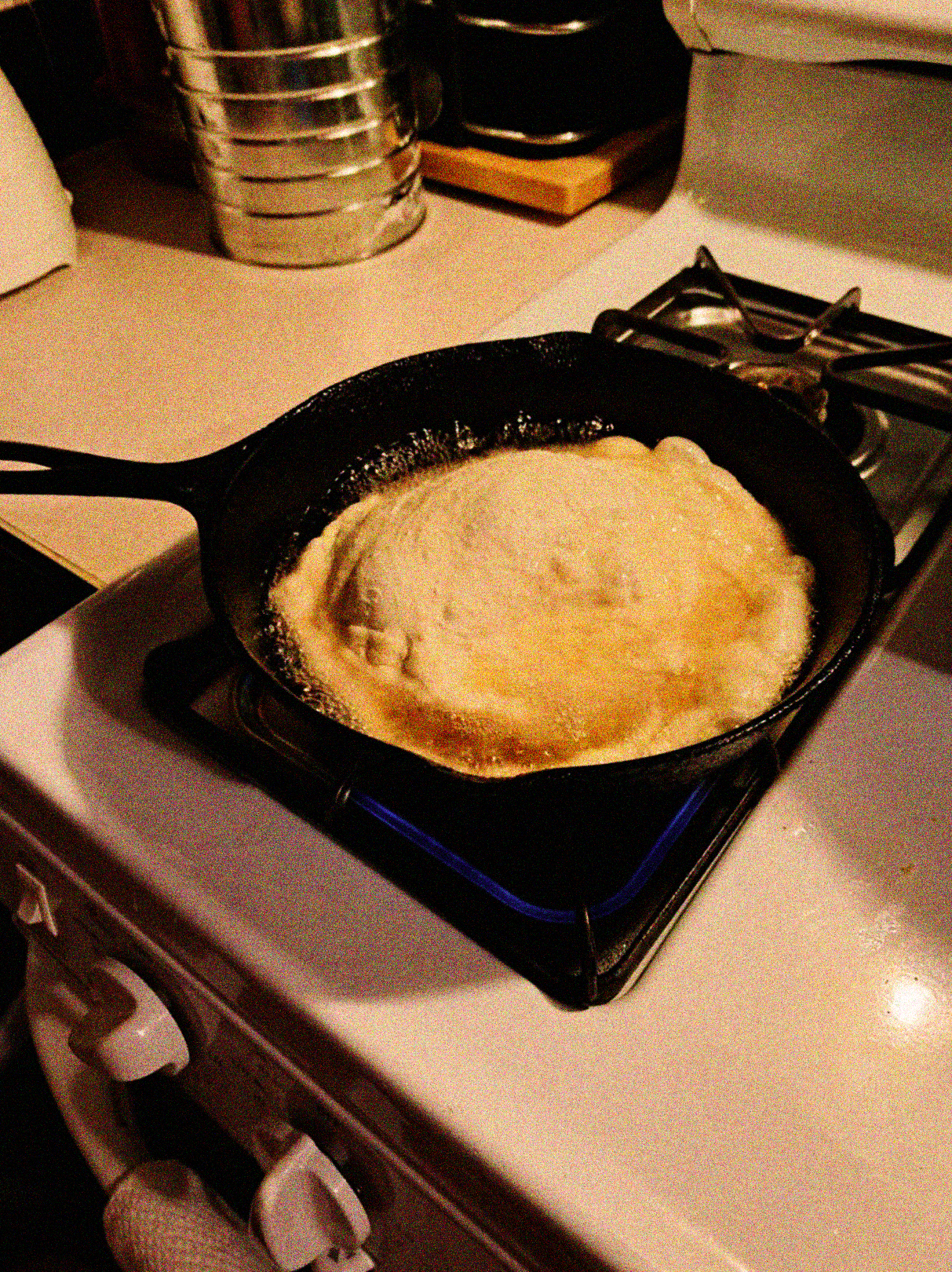
While this collection has roots in Diné thought and lifeways, Blue Corn Tongue also makes room for a Diné identity that yearns for more. In the poem “Shíma and Shí,” Amber sees herself in her mother and their shared desire for more beyond their small town. Even if they may not physically leave the southwest, their dreams are reflected in what they are able to create in their home space, including the gift of a meal shared among family. Amber writes, “Frybread flying me to continents / Mutton stew showing me new languages / Spam burritos guiding me to cultures”. Here, the familiar foods for many Diné households takes on a worldly quality that longs to experience new things while still retaining a sense of belonging to community and to tribal nation. These lines put a spin on the Diné belief that one must always think positive thoughts when cooking for our loved ones. Amber raises the question: what happens when we dream? What happens when we offer nourishment in support of dreams? Often, we look back at our lives and reflect on the many unfulfilled dreams. We ask about our mothers and their dreams that went unsaid. Yet their lives unfurled in beauty. Amber ends the poem with “digest a strength / to go out / and / walk / many lives, paths, worlds, feasts / Shí// ma.”
As a Diné poet, Amber recognizes the patterns and reverberations in Diné lifeways that connect us to the emergence stories and to ancestral relatives like Changing Woman. She situates her saad (words, language, and voice) as part of a larger continuum of stories reflected in Diné ancestral beliefs. In the poem “To Change and To Be the Five Fingers of Her,” Amber sees the beauty and brilliance of our Diné relatives with the lines “stars birth sheepherders with fast legs” and “weavers with mathematical wit.” Present in our Diné lifeways like weaving, including the processes of raising sheep, shearing, and spinning wool, is the grit and intellect necessary to create beautiful images. Not only is our cultural imagery something beautiful to admire, but so is the belief and the innate geometry. How amazing we are as Diné!
Alongside poems of beauty and connection, Amber grapples with the ecological violence of uranium mining on Navajo land in a series of poems labeled Book of Łeetso. The word “łeetso” stands for uranium and references the violent history of uranium mining on the Navajo Nation with a site near Tsoodził that produced the largest deposit of uranium in the country. In support of war efforts, Navajo lands contributed thirty million tons of uranium ore from 1945 through 1988, according to the article “Leetso: The Powerful Yellow Monster” written by Esther Yazzie and Jim Zion. Yazzie and Zion go on to state that at least one thousand abandoned and unreclaimed uranium mines exist in Diné Bikéyah, and the full extent of the toxic waste from uranium mining hasn’t been made clear. Amber acknowledges this violence as part of Diné history and focuses her reader’s attention on a uranium mine spill in Church Rock, New Mexico on July 16, 1979. Her poem titled, “Church Rock Uranium Mill Spill,” provides a loose timeline of the event. Amber writes on the site of the uranium spill: “A river that gave life and water / to the livestock of the Diné / Where children played / and where Medicine men gathered / native plants and remedies / for ceremonies.” In the history of this country, Native people continue to experience violence and disparities in healthcare, access to healthy foods, income, housing options, and so much more. Rather than dwell in the many wrongs committed by the settler state, Amber encourages her readers to continue living meaningful lives that continuously strives for hózh= and k’é. Through it all, we never forget who we are and the power in our language and stories.
To live meaningful lives in pursuit of hózho also involves love, meaning family love, love for community, self-love, but also romantic love. The love of a supportive partner. The love to build a life with someone. In works by Diné poets, we see romantic love in works by Luci Tapahonso and Laura Tohe, and now, in Amber McCrary’s work. Amber writes in the Afterword to Blue Corn Tongue: “Falling in love as a Native person is funny; so much is involved with intergenerational trauma, and there is enough baggage to fill a dump truck. I hope Natives can see my love (as a Diné woman) for this person.” In our history with boarding schools and the many other traumas inflicted by colonization, Native people have been called terrible things and made to feel lesser than. This has impacted our ability to love, not only ourselves but another person. In the poem “TC Coincidence? I Think Not!,” Amber writes, “You continue to repeat romantic Rez words / and look into my eyes.” The speaker of the poem shares an intimate and playful moment with their love in their shared space. The playfulness is in the speaker’s love saying to her, “Shi heart, Shi Girl” and the speaker laughing so hard “my cheeks might explode.” This love is healing and restorative. The poem continues with the speaker seeing her love reflected in a painting of an O’odham dance: “Men and women are holding hands / they are in a circle sidestepping with each beat” and the speaker thinks to herself “your olive black shoulder-length hair and horizontal mouth / look like the T.O. grandpas round dancing in the painting.” The speaker continues, “I like to think of an old you, cheii you / your hands the color of theirs / hickory with darker hints at the knuckles and elbows.” This love allows the speaker to imagine a future for her partner and for herself. This love encourages growth and stepping into old age. Amber shows the reader that to love is to imagine a positive future despite life’s challenges and the continued legacy of colonization. To live, we must love.
Amber McCrary’s poetry collection Blue Corn Tongue is a must read. In a conversation with Amber, she says, “I hope Diné readers are empowered to write or tell their own story…I hope they feel seen or relate to the material…it’s never too late to accomplish your dreams.”