The Harvest of Knowledge: Exploring the Cornstalk Philosophy and Insights from the Dream Field
by Shaina A. Nez, Ph.D.
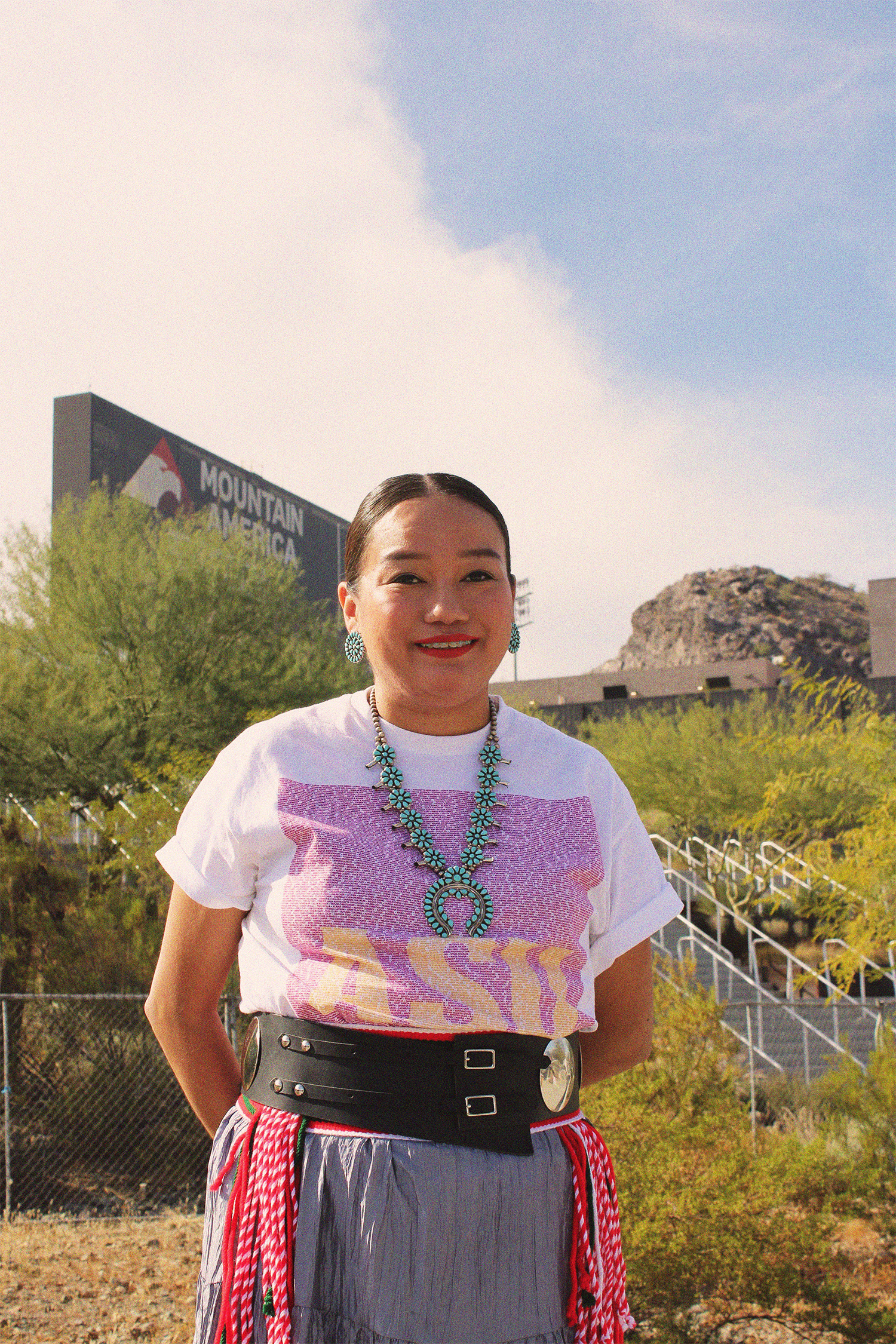
Dr. Shaina A. Nez is Táchii’nii born for Áshįįhí. She earned her Ph.D. in Justice Studies from the School of Social Transformation at Arizona State University. Her recent contributions include the essays, “COVID-19 Memory Dreamscape” in COVID-19 in Indian Country (2024), edited by Farina King and Wade Davies (Palgrave Macmillan), and “Diné Brevity as Indigenous Theory” in Indigenous Poetics: Native American Poets on Method and Expression (2025), edited by Inés Hernández-Ávila and Molly McGlennen (Michigan State University Press). Her scholarship weaves together critical insights from Diné traditions and contemporary theory exploring the intersections of worldview and memory. She is originally from Lukachukai, Arizona.
The Foundation: The Seed Planted
In Lukachukai, two miles east of the old Lukachukai Community School campus, there laid a cornfield belonging to a man once called Hástiin binaa’ dootł’izh, ałk’idáą́ jiní. His wife, born Táchii’nii’ children and together, they grew corn short of an acre long. Locals admired its beauty back then even when planting was common; having no reason to gossip or spread bad medicine, especially during the blue hour. They knew corn needed nurturing and care from the hands preparing the soil; the children’s hands were perfect for this stage. Children hold abundance on their palms and when their fingers prick into the soil they are greeting back to mother earth and land. Some believed your cornfield was a reflection of your family; Hástiin binaa’ dootł’izh dóó Asdzáán łich’ii had nine children, lived in a hogan, and for irrigation, had a water source beyond the Tó Tsoh that crossed through the town into a tributary. For their children, the cornfield awaited a place where dreams and endless possibilities flourished. For Hástiin binaa’ dootł’izh and his wife, the cornfield was a place for many generations to remember the seed of knowledge was planted for a reason. Their foundation can never be broken, ałk’idáą́ jiní, they continued to plant and prosper.
Two, or maybe three, decades came and went, and the cornfield began to change. Once close to an acre of stalks standing tall as far as the eyes can see. Soon, the cornfield began to shrink. As the children became adults, talks about living on the land with their own homes seeped into conversations at the dinner table. At the time Hástiin binaa’ dootł’izh was asked by some ‘big shots’, they referred to anyone in leadership, about Diné-based philosophies particularly the Cornstalk Philosophy that he once learned from Hástiin dzanez dootł’izh, another man who carried the color blue in his name also. At that time, Navajo Community College was undergoing relocation and locals said they were planning to house the institution in Tsaile, Arizona, fifteen miles away. The ‘big shots’ were twin brothers with the last name Jackson. Because they were twins, many believed they resembled the Navajo twin warriors, Nayéé’ Neizghání and Tóbájíshchíní. In the creation stories, the twin warriors were the only hope in the third world, fear preyed upon the people through monsters of all shapes and sizes. The brothers faced the people’s fear and fought back ridding the monsters of their demise. Hástiin binaa’ dootł’izh often wondered who the monsters were in this case as plans for the ceremonial groundbreaking commenced.
When Hástiin binaa’ dootł’izh was paid $250 to share the cornstalk philosophy and to prepare the ceremonial gish for the college’s groundbreaking, he was puzzled. The twins told him you have much knowledge to share, but do not share it for free. Although Hástiin believed knowledge should be accessible, he knew better than to question the twins and thanked them for the advice. In k’é, Hástiin spent day and night preparing the sacred gish with greasewood while silently praying, meditating, and singing. Although he didn’t carry one of the four sacred clans brought by Asdzą́ą́ Nádleehé, the leaders depended on him because he was a man of promise. At this time, Hástiin’s oldest son, whose name resembled náshdóítsoh bitsiijįʼ daditłʼooígíí, also conducted an azeé bee nahagha ceremony the night before the groundbreaking. As the cornfield continued to grow over his son’s developing years, somewhere along the way he began to embrace the practices of the Native American Church learning from the tribes up north about peyote and the stories, songs, and teachings that came with it. Personally, Hástiin worried about his son carrying on these teachings instead of the cornfield knowledge, but what could he do? His son shared many facets of himself through song and dance, but because his son was building a name for himself off the homeland, he convinced himself that his fears weren’t necessary and that he trusted the medicine to lead the way. The news of the groundbreaking for the college was fast approaching and another man, too believing in the peyote medicine, hosted a second ceremony in his homeland. When twin brothers sat in ceremony, the bond between them and hástiin grew and strengthened. Somewhere along the way, they would cross paths again, if not them specifically in other forms too.
The cornstalk philosophy, like planting, depends on a cycle and seasons from traditional teachings. When preparing the earth, Hástiin’s children learned to space the placement of the seeds, their eyes shifted from seeds to soil until they became cross-eyed. The children laughed at themselves knowing the seeds would carry some playful humor, too. They daydreamed of the stalks swaying and dancing together like during the first night of ni’daa’. The oldest reminded them about water and weed control, it’s not about how fast you can seed it’s about the intentional care you provide to them every day, he said. The oldest son did his best to still be there for his siblings. Eventually, the boys will become men and they will also live between traditional teachings and NAC. The sisters will learn to bring in the water and pray for their loved ones, they will go on beyond the kitchen instilling love into everything they are asked to do and lead, in most ways, like asdzáán łichii.
While twelve ears on a single shank were uncommon in the planting realm of non-Natives, here in the Dream field, with the proper prayers, songs, and teachings from a Diné worldview, abundance thrives. This foundational story comes from my maternal family in Lukachukai; I am the great-granddaughter of Hástiin binaa’ dootł’izh dóó Asdzáán łichii and I write about this today providing proper care for the growing ears of this cornstalk narrative.
The Cornstalk Narrative: 12 Ears Resembling 12 Narratives
- In 1990, a seed was planted for me in Shicheii’s homeland that now dwells on a section of the Dream field. In an NAC ceremony, my relatives pray for my development as they’ve done for the cornstalks they planted many years ago. My paternal family attended the ceremony also. It is a special story told to me by both parents of how shimasaní dóó shicheii dóó shinalí asdzáán dóó shinalí hastiin’s presence, prayers, and songs are now alive and well in my being.
- When my parents first met in Logan, Utah, my mother worked at Pepperidge Farm on the night line and during the day worked on jewelry; my father worked at a meat-packing plant while awaiting a call for his first day in ironwork. He came to Logan after graduating from a Native American Ironworking training program in Chicago, IL. On the night they met, they were dancing getting to know one another through story and movement. My father assumed my mother was not Diné because of her fair complexion; little did he know, that not only was she Diné but she was from Lukachukai, Arizona. The only family I know in Lukachukai are the Blue Eyes before they became the Harveys, he said. ______ Harvey is my father, she replied, and Hástiin binaa’ dootł’izh is my nalí. My father’s stare held hers in disbelief until my mom asked, ha’iish nilí?
- Father received his call to work in Ft. Lauderdale, FL, a couple of months later; the company sent him traveling funds for relocation. By then, my mother and father were happily in a relationship. My mother learned about my father’s upbringing in Teestoh, Arizona, specifically in a place called Tiis Sinoo’yelí: she learned he was never intimidated by hard work; he once spent an entire night alone looking for lost sheep that his little brother left behind. I imagine a little boy in the night playing with rocks and sticks imagining he was in a different place than this one. He returned the lost sheep to the corral with a couple of hours left to sleep before getting up to do all of the same chores again. A boy who lived on hand-me-downs, receiving one Life Savers for Christmas, appreciating everything from sticks being thrown at him to move faster to him going up to his mother and hugging her after he was scolded in Diné bizaad. My father had no complaints growing up, he knew that it was all love in the end.
- No more hiding my belly now, my mother said, when she noticed her stomach rounding near her bellybutton. I was in her womb, swirling in the tó still forming. She told my father that two weeks before I was born she wanted to fly back home to give birth. My father promised to fly back the days leading up to it to bury the placenta at its proper home.
- I was born on April 6, in the evening time when prayers ended with reflection; rejuvenating themselves for the next day. Shimásaní named me Shaina saying that during the ceremony she envisioned a tall woman with long hair. Shicheii added to that vision saying I will be strong and fearless. Shinalí asdáán envisioned a tall, fearless woman, who climbed the ladder of education, and shinalí hástiin envisioned me with a heart of gold because no matter what happens in life I will always be grateful for the obstacles and opportunities that will come my way. The seed they planted in the Dream field those many years ago remains in the sacred earth telling me this is where I belong. Remember that, the Dream field said.
- At the end of my ceremony, shinalí asdzáán introduced herself and began to share where she was from before marrying and carrying the name Nez. Her maiden name was Jackson, and she said the twin brothers, _______ and _______, were her cousins. Paths crossed again, and this time, it was to celebrate my existence and the wonderment of time in the space of prayer and medicine. I carry these names, Harvey, Nez, and Jackson, as my symbols of hope, strength, and perseverance.
- The Dream Field now houses children, grandchildren, and great-grandchildren’s homes. Although we continue to grieve for Hástiin binaa’ dootł’izh dóó shicheii, all we have to do is walk across the field to understand the teachings of the Cornstalk philosophy and apply the knowledge of the ears to our lives.
- The times I ever planted corn were elsewhere than in the Dream field; once during my internship with the land grant office in Tsaile, and another, with a friend, who was telling me stories about her challenging relationship with her son’s father. While she talked my ears off about the situation, the story never changed her movements from seed to soil. I listened to every detail, sigh, laugh, and shaky uneven tone of voice when she talked about planting with her family long ago. However, because she didn’t have the best relationship with them now she sees planting as a way of rekindling their bond from afar. I started to think about rekindling bonds from deep grief; my parents, aunts, and uncles from both sides were knee-deep in it and eventually, it came to us grandchildren. At this time I pause, for what feels like decades of knowledge dwindling. But no, that’s the fear talking, the Dream field said, the knowledge is still there you just have to touch the earth and listen.
- My cornstalk of knowledge formed when I signed an agreement to participate in the Navajo Nation Doctoral Cohort, a collaboration between the tribal college in Tsaile and Arizona State University. My love for stories came into play, for the only way I could even grasp the meaning of Indigenous research was that it relied on knowledge that was passed down by a knowledge holder. There, I began referring to my elders as such, and I learned how to embrace the title of knowledge carrier the more I progressed in my coursework. My mentor at the time reminded me to step into my power; every passing grade and sleepless night symbolized a step up the ladder. Sometimes I wonder where the phrase ‘climbing the ladder’ really came from pushing inquiry beyond the popular song written by Arliene Nofchissey and Carnes Burson. A former instructor’s voice will repeat these words that Chief Manuelito never expressed the importance of education, and whether what he said was true or not, that outburst remains in my memory from my undergraduate years. I further inquire about Diné education making connections from the Dream Field to my worldview.
- When the cohort was assigned to read dissertations written by other Diné researchers, I came across one titled, “In Becoming Sa’ah Naaghai Bik’eh Hozhoon: The Historical Challenges and Triumphs of Diné College,” written by Ferlin Clark. I remembered Mr. Clark as a Diné College president back when I attended from 2008-2011. I remember when I no longer had a physical home to go to, Mr. Clark granted my sister and me emergency housing to stay in during the academic year. He did right by us, as students at the time, and I never understood why he was ‘let go’ just weeks before the Shiprock graduation ceremony. I low-key wished he signed my degree back then because he believed in going the extra mile for students as any true leader would. In the pages of his dissertation, I now know the true story of the college groundbreaking and my family’s participation. I hold that knowledge dear to me because it exists just like the gish my great-grandfather prepared close to 54 years ago with the intent that the college would continue to prosper only if it’s cared for and nurtured like planting corn.
- As a child, I had a fascination with the English fairy tale, Jack and the Beanstalk. Instead of the beanstalk, I dreamt of a cornstalk and connected the Diné emergence stories by Mr. Secatero to understand another aspect of how the people were able to emerge from one world up to the next. Perhaps the people and sacred beings were climbing up a cornstalk until they reached the plume and bluebirds? My practices of deep social inquiry were high then as I began writing the first chapter of my dissertation; my brain was in a state of daydreaming endless possibilities and usually I’ll let those thoughts coast on autopilot until I snap out and re-read paragraph by paragraph my introduction typing at warp speed. I have no name for this practice, but I trust it every single time when my thoughts are fixated on a specific time and I allow curiosity to linger.
- A month after receiving my doctorate in the mail, I continued to dream about the cornstalk philosophy. I open the manila and breathe in my degree with four long inhales. I’m thankful for this full-circle journey, whether I climbed the ladder or the cornstalk of education for 15 years. I lightly think about my future as the plume. I pray about my next chapter in life and embrace the state of Hózhó. The next offering will be back on the Dream field, calling forward the plume, pollen, and bluebirds.
Harvesting the Wisdom of Corn Pollen, Plumes, and Bluebirds: A New Dawn of Growth
Hayoołkááł
One blue hour in Wóózhch’ííd, shiyáázh graced a namesake as the cool brisk air first formed
your breath. Your being cried earth-shaking wails telling the world that you have arrived crossing
over from the galaxy of the womb through blue and red planets and onto earth. Your existence
shook the peaks in all directions, this abundance from a fresh womb was restored. The world
begins in the hues of blue when beautiful creatures dwell on land, flora, and fauna greet each
other and intermingle, and they chant a million warrior songs in your name. Your existence
brought balance and peace to the blue world. Birds of all shapes and sizes carried your being
from the next world and the next. But the birds didn’t know ten pounds of tó came along from
the second world to here.
Hayííłká
When the fluid was released from your body, air resurfaced. This air was also the same cool brisk that brought you into this world as a sign of restoration. Like shimásaní once said, if I go now I will miss the blooming lives of my grandchildren—the same cycle of love propels in your veins and we think about that time when our youth was like the blue world full of endless possibilities to dream and believe. A burning flame appears when you begin to tell a story and I listen to the riffs of your bird song in line with a pulsating heart. If we believed just enough in this collaboration of sound, story, and breath I would no longer be skeptical of a sisterhood escaping from the greatest flood in the blue hour.
In conclusion, the cornstalk philosophy and the Dream field can teach us important lessons about resilience, growth, and connection. Just like how a cornstalk grows from the soil, adjusting to its surroundings and supporting the environment. They encouraged me to face challenges with strength, learn from my surroundings, and always find a way to help others. This philosophy reminds us to stay true to our values and stories while being flexible and open to change. By following your dreams and ideas, we can grow personally, and professionally, build better relationships with our worldview, and live more meaningful lives by remembering our purpose on the corn pollen path.
Leading The Way Vol. 23 No. 6