
Where East Meets West: Kevin Wilson on Cultural Meshing and Cultivating Community Spaces
by Dr. Manny Loley, LTW Editor
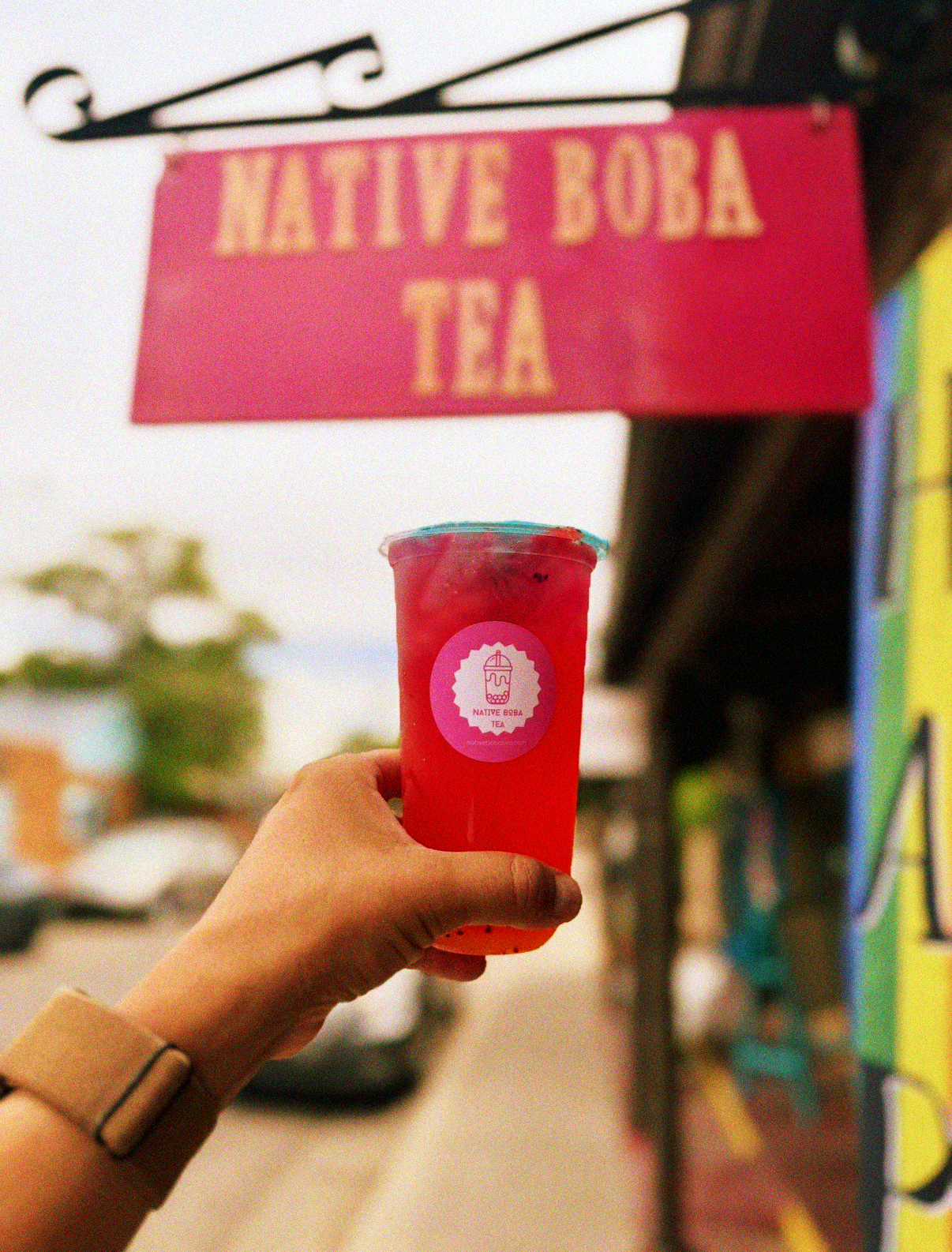
Nestled in Old Town, a historic district in Albuquerque, New Mexico, alongside shops, jewelers, eateries, and other interesting venues, is a Native owned boba tea shop where “East meets West.” Native Boba Tea is serving a unique blend of Native-inspired flavors that showcases the culinary talent of the Southwest, especially the Indigenous Southwest. Originating in Taiwan in the 1980s, boba tea quickly spread throughout Asia in the 1990s and later, became a global phenomenon. At its core, boba tea is an iced milk tea with added tapioca balls (pearl or boba) and other flavor combinations. All across what is now the United States, boba tea shops have gained wide popularity with each shop adding their own unique twist to the drink. The boba tea’s popularity has even reached the Navajo Nation with several Native-owned boba tea companies selling at various markets and now, Native Boba Tea’s storefront in Old Town. Native Boba Tea is serving up unique boba teas and baked goods. I had the chance to talk with Kevin Wilson, owner of Native Boba Tea, about the origins, inspirations, and overall story behind his passion project.
ML: Thank you so much for taking the time to talk with me. I’m super excited about featuring Native Boba Tea in the magazine. I had a chance to stop in a few weeks ago and I had a really good experience. The person that was running the store that day was so great and so kind. It’s just a great space so thank you for giving us your time.
KW: Of course, no problem. I’m glad you had a great experience. We always try and do our best to make sure everybody has a great, positive interaction to get them out of whatever they may be going through during the day. That’s awesome to hear.
ML: Great, so I’ll be a little sporadic in my interview, hitting on different topics that I’m curious about. The first thing that we can discuss is a little bit about you. Who are you? What is your background? Where do you come from? What are your clans?
KW: Sure, my name is Kevin Wilson. I come from Nazlini, Arizona, a community between Ganado and Chinle. I graduated high school from Ganado in 2003, so I’m full Navajo. My mom and my father are full Navajo, so my clans are Kinyaa’áanii (Towering House People) nishłį́, Deeshch’iinii (Start of the Red Streak People) báshishchiin, Táchii’nii (Red Runing into the Water People) dashicheii, Ta’neeszahnii (Tangle People) dashinálí. I started off not so much as an entrepreneur in the beginning and then in the last few years, I really started wanting to venture out and do a lot of different things that I felt tugging at my heart and a calling for. When I was working in corporate America, I felt like my career was kind of stagnant as far as wanting the freedom to do what I wanted to do versus what the corporation wanted to do. I used to work in the service industry as a bar manager, bar tender, mixologist, and I got a little taste of that freedom that I was needing and that was the creativity to do my own thing. By doing my own thing I mean creating my own drinks, creating specials, making sure everyone had a positive experience.
After I left that world behind and I went to corporate America, I started to become more boxed in and more behind the desk. I started realizing fairly quickly that the higher you go, the higher ladder you climb, the more time you spend behind the computer and the more isolated you become. It started to feel like it was closing in around me. I was basically going to sit in a seat until retirement and that kind of scared me, so I started to venture out and see what I could do to use my creativity. I started a YouTube channel called Kev the Bev ASMR where I would review Navajo foods. I would encourage others who didn’t know about the Navajo culture or any of that sort to kind of just relax. It was kind of a service to explore my creativity but also to help those with anxiety, those who need help with sleep deprivation. It was a very niche, unique experience for the viewer or listener to really hear my take on ASMR because there are so many ASMR artists on YouTube. I thought maybe I could offer something. That turned into a podcast called Excused! Podcast which ran on Spotify and Apple Podcasts. It’s still on there. I started sharing my experience from the beginning and then throughout the podcast I also bore the inspiration for Native Boba Tea. That was really through an ASMR video on YouTube where I was doing Navajo Tea, or Indian Tea, however you want to call it. Then I started to turn it into a boba drink, and that’s how Native Boba Tea was born. Throughout the podcast, I would talk about my vendor pop-up set ups, life changing experiences that I went through at the time, and it kind of shadowed and followed me throughout what I call the boba tour for Native Boba Tea. That was a 2023 tour where I hit up a lot of places on and off the reservation. I met a lot of interesting people. As time went on and the business became even bigger, I had to take a little bit of a pause on the YouTube and the podcasting just to dedicate and give Native Boba Tea its own space and so here we are.
ML: Awesome, thank you for that. I feel like you’ve touched on a lot of really interesting and important ideas, especially for younger, Navajo people that are transitioning from maybe living on the reservation, going to high school, and then pursuing post high school opportunities like college or some other kind of trade or even the military service where you’re so used to thinking about and experiencing the world in a specific kind of way but then you get into college, or you get into post high school work, or how you’re saying the business field and it feels as though these systems don’t always mesh well with who we are as Native people and where we come from. So, I really appreciate you outlining your experience with that and I think that’s something that a lot of our readers, especially the younger readers can relate to and reflect on. Thank you for sharing that.
KW: Sure, of course.
ML: Yeah, and so when I was reading through your website, Native Boba Tea is self-described as “where East meets West,” and I was wondering if you could talk a little bit more about what that means.
KW: Sure, of course. So, Native Boba Tea comes from a collision of two cultures. Here, in America, its founded on immigrants and Native peoples who have always been here, and this fusion bore such an immense wealth of foods, cultures, identity, and that sort. Being a country where freedom is supposed to be the main priority in identity, and you know, welcoming different flavors of food and that sort of thing. So, taking this spin on something that was happening in the East, in East Asia, and taking all the cultural references as far as boba tea and seeing how it was starting to catch on, I felt like we had an opportunity with Native Boba Tea to fill a very specific, unique niche that can fuse those cultures together. Because the Indian tea, the Greenthread, for us here living in the Southwest, we use it as part of maybe a daily process, whether or not through ceremony or you know we go out and pick it during the summer. We enjoy it. It’s something that we can look back on fondly and really know that the tea reminds us of home. Using that to bring it into an Eastern stance, and a more modern stance with boba tea, it was the perfect opportunity for me to use my background as a mixologist and to give myself the freedom to fulfill what my soul was yearning for. So, I created a collection of drinks, signature drinks, nondairy milk teas, refreshers, lemonades, and half teas to really speak to what we enjoy or what we can do as Native peoples. To create a space specifically for Native peoples so that way they can feel that they have something new, something fun, something cool that they can enjoy and look forward to and go out and see and share with their friends and find themselves even if it’s at a pop-up market or if it’s at a brick and mortar. They can feel welcomed and feel at home. And of course, non-Native peoples can enjoy the collaboration and see what we offer and what we’re all about as a whole people and really bringing everyone together.
ML: Beautiful, thank you for that. I was really captivated by this idea of cultural meshing, right, so finding ways to infuse cultural flavors, tribally-inspired flavors with this more global phenomenon of boba tea. Doing a quick internet search, boba tea originated in Taiwan in the 1980s, and then quickly spread throughout the world, especially in North America, right? So, we see boba tea not only in larger urban spaces like Albuquerque and Phoenix and different urban centers that are near the rez, but we also now see it in your shop but also in other Native owned companies that are bringing boba tea to the Gallup Flea Market or even to different kinds of ceremonial gatherings where they have different kinds of pop-ups. You spoke about this a little bit but I’m wondering if you could elaborate on how do you see the unique brand of Native flavors, Native cuisine, Native kind of tastes playing out in this globalized market of not only boba tea but also the potential for these Native inspired flavors in a general global perspective.
KW: Yeah, so I’m glad you touched on that first part too because that’s where I started out was at the Gallup Flea Market a few years ago in 2023. For Native Boba Tea, our most basic flavor would probably the Indian tea with honey popping boba, unsweetened. So, I know that masani’s, cheii’s, those who live on the reservation who enjoy tea during the summer, they would drink it hot with honey or sweetener and that sort of thing. Native Boba Tea was a more modern way of updating it and drinking it cold and iced during the summers. What we have to offer as far as like being on a global scale would be that because the Indian tea grows from the borders of Mexico north to Canada and is found along the sides of the mountain with tribes in the deserts, its really localized in originating from North America. So, let’s say for instance Jasmine tea is found in the East. You know there’s certain teas that are very popular that you can only find in one portion of the world and I think with the Indian tea, Greenthread, or whatever you want to call it, that’s very localized to the market that we want to represent. And so being that we want to pair that and offer that on a bigger scale, I think it’s really special because that’s something that we can be proud of here in the Southwest and that we can use to tell a story of the Southwest.
In essence, you know with turquoise we always think of Native Americans and the Southwest. We think of frybread as part of Native culture. With Native Boba Tea, we want to include a piece of that cuisine to offer on a global scale, as well. We also do different things at the shop to incorporate those Indigenous foods such as blue corn cupcakes, blue corn cookies with toasted pinon, and we want to offer even more than just boba. We’re branching off into a bakery so you can have a whole experience and be something that’s Native American true, New Mexico true. Knowing that Native Americans come to the shop and enjoy it, that tourists can come to the shop and know that they’re getting the real, authentic experience. So, we just want to be here and offer something special.
ML: Awesome, thanks for that. I really appreciate that Native Boba Tea is taking the step toward expanding how we think about Native identity. Because I feel like, especially our experience with Leading the Way Magazine, a lot of the time the general populace has a very narrow view of what Native identity is and how it can look like. But one of the things that we strive to do, and it sounds like you’re striving to do that as well, is to get people to think about how our ancestors in the past were actually global citizens and you see that in how different kinds of stones, different kinds of materials, made its way into the Southwest through trade and doing that trade through multiple kinds of languages. I’ve heard a variety of elders say that at one point, Navajos were a multilingual people because they had to know Spanish, they had to know Puebloan languages and other languages to trade and to incorporate some of those other cultural elements into our culture as Navajo People. I really appreciate all this work that you’re doing and all this cultural meshing that’s happening because I think it’s important for our young people to see themselves not only as proud Navajo people but also as proud global citizens. So, thank you so much for that. I appreciate it.
KW: Sure.
ML: And so, as you were talking, I was also thinking about the physical space of Native Boba Tea. It’s so interesting that Native Boba Tea has its physical location in Old Town, and Old Town is this very historic part of Albuquerque. Historic both in the sense that it brings a lot of tourism to the city but historic also in the sense that it also has its roots in darker history like colonization and things like that. So, I was wondering how did you decide to set up shop in Old Town? And what are some of your thoughts and feelings about being set up in such a historic location next to these trading posts and other jewelers that sell Native art and other things?
KW: Well, thank you for touching on that cause that also is a part of the statement that we, as Native peoples, are taking and becoming more, I guess the closest word I could use is woke, and reclaiming our identity. Especially in times like this, we need to be making moves and doing things that represent us and be unapologetic about it because no one is going to do it for us. We have to write our own narrative.
With the Old Town location, I was looking for a location probably well over a year and I did pop-ups for two and a half years while working my corporate job. So, there wasn’t a day that I didn’t work. I would go to work, work my salary job, get off work, go shopping, pick up some things, get into bed, and then do that five days a week. Go to Gallup. Wake up at 3 am. Do a pop-up sale there. Come back to Albuquerque. Do a pop-up sale at a market here in town. Take a 30-minute break to break down the pop-up. Do a night sale at another pop-up event. And literally I would just go for two and a half years straight. I really wanted to focus on putting my whole energy and effort into getting a brick-and-mortar shop. And so, when the opportunity for Old Town came up, I remember one time I got off the bus years ago on Central and I was walking through Old Town on my way to my bar managing job, which isn’t too far from Old Town, and it was at the Hotel Albuquerque, and I was thinking gosh, one day you know I would love to have a shop here. One of my favorite restaurants was there and they had since closed, but I was just thinking gosh, it reminds me of Santa Fe. It’s so nice and quaint. You know, this is a great area. I love it. It makes me feel happy. So, fast forward 10 to 15 years later, I felt like okay there’s a space here, let me look for it, let me see what’s going on. I met with the landlord to see what we could do. The cards just worked in favor of being able to open the shop, but really with, like you said, the dark history that we had with how the Spaniards had enslaved Native peoples, the whole Long Walk, I felt like there was a calling for me to put in a brick-and-mortar where maybe you know 300 or 400 years ago it would have never looked like that. Having a Native owned shop in such a colonized space that was controlled so horrifically, it was a kind of stance to show that yes, this is what my ancestors had died for, suffered for. Our ancestors, as Native peoples, they went through so much. They probably couldn’t fathom, fast forward a hundred years later, that we could be reclaiming our identity. Opening up shop, being in a space where maybe they weren’t welcome as much before and kind of taking that power back.
It’s very interesting to see the collection of folks that walk through the door at Native Boba Tea. Of course, you have folks that aren’t from the area who are tourists who appreciate the authentic experience and then those who are local, maybe not even just Native Americans, who understand that “wow, you guys are really doing good and you’re kind of reclaiming your own story.” I’ve spoken to shop owners, as well, who aren’t Native American, and they really appreciate that we’re there selling Native American artisans work from the artists themselves. And since it’s a Native American owned shop, they always ask me, they’re interested in “how does that make the artists feel? How does that make the customers feel? I bet it’s amazing to have all these Native owned shops and that you’re selling your own wares there.” It’s amazing. It’s awesome to see. I know a lot of the people who come in to shop who are Native do really feel welcome. They see themselves. They see their family. They see their whole culture in the shop, and they feel welcome. This is a place for us. Those who aren’t Native appreciate being around such a rich culture and they love coming back so we always try and do our best to keep that medium and keep it going because it does mean a lot to us historically and today.
ML: Thank you for that. I can definitely see how the physical presence of a Native owned business, a Native inspired business that’s carrying Native crafted materials and food items, is such a powerful statement being set up in that space. I’m glad the shop has had such success and is being recognized in different kind of venues. I think that brings me to my next question about what are some of the projects, some of the causes, some of the different kinds of promotions that the shop is involved in now? I saw on your social media page that there were different kinds of events like Summerween and then also some things with animal rescues and some larger events with Native creatives that you’ve been involved in. I just wanted to hear from you some details about those experiences.
KW: Yeah, sure, so when I went to do all of my pop-ups on the reservation, as we know, there are many stray dogs. Unfortunately, people do dump them off. People don’t get their dogs taken care of as far as spaying and neutering as much as you would find maybe in an urban area. So, those dogs tend to have puppies, more dogs, more strays, and the problem continues. Sometimes it’s really hard for me as a person who respects Mother Nature, who respects all the beings, whether its human or animal. It’s hard for me to turn away and know that maybe this dog might be suffering, or starving, or isn’t gonna make it or could be runned over. Along the way of my pop-ups, I rescued about three or four strays. I just don’t have the heart to turn them away. Whenever I rescue dogs, I’ll bring them back home and help rehabilitate them to be an awesome rez pubby. With that, I wanted to do something special for our Native and non-Native customers who might be looking for treats. I started Rez Pubby Treats to help embrace that area where you can find treats for your dog as far as homemade, wholesome ingredients. That way when you go to the store, you’re not giving them products that might have glycerin or harmful chemicals in them that’s mass produced. You don’t know what’s in them and you might harm your dog in some way. It was my way of giving our four-legged friends a piece of love from Native Boba Tea because wherever we were at we were always around our rez pubbies.
For the YouTube Collective Creative Experience, that was a YouTube collection of artists who are Native and who have original content. It was Lonnie from New Mexico Community Capital who reached out to me for that event. I told her I would go because it sounded amazing and a great opportunity to come together and meet other Native Youtubers and see what the consensus was about where we were at, what platform we were showing ourselves in, and to see who we could collaborate with and have a great time. That was a great experience, so I thank her for that and I thank YouTube for that experience, as well. So, really I was just involving myself in different areas because I know Natives up-and-coming we probably don’t have as much representation as other ethnicities and races and that’s okay because it gives us more of an opportunity to start writing our own story. Now, we have Native filmmakers, writers, cooks, and others and I think that’s wonderful.
That was one of my passions was to follow your passion. Being a millennial, we kind of grew up in that mindset that you can only be one thing when you grow up and you have to stick with it until retirement. That didn’t really sit well with me. So, involving myself in so many projects and trying to keep up with it was really my idea of saying if you want to do YouTube, a podcast, or be a business person, why not wear all the hats and enjoy it? You only get to live this life how you want to live it. It’s a great opportunity, so why not do it?
When I first started my pop-ups, I did giving back type of sponsorship. I did have a team that I sponsored go out to Las Vegas for the Native American Softball League. It was a great opportunity, and I had the capital at the time from the pop-up sales to sponsor them. It was really kind of my way of giving back to the community showing how they supported me at all the pop-ups this year. I really appreciated it. So, in return, we went ahead and sponsored this group to buy their team bracket. It was one of those things that I was really proud of. I do like to keep that in my mind as far as making sure that we can give back to the community who take so well care of us. That was probably in 2023, and there was a couple more sponsorships I wanted to do especially this year. I’m starting to pull back a little bit. Unfortunately, since the new administration took over it’s starting to change a bit of the tourism and climate as far as the traffic in Old Town. Once things turn around, I’m hoping to start taking more on.
Last week, we did a partial donation for the Jock Soto tribute that was in Santa Fe that was put on by the Lensic Theater in Santa Fe. There was a nice lady that reached out to us and wanted to get together and see how we could donate some cookies. We sat down and collaborated. They purchased a batch of 50 cookies for the event so they can give it out so that was great. We worked with the Indian Pueblo Cultural Center a couple of weeks before for an event they did for their conference and that was amazing. It was such a great opportunity because everyone was from out of town. So, we really appreciate being able to work these events, donate when we can, sponsor when we can, and keep adding more to our plates so we can show up for the community.
ML: Awesome, that’s so great. That’s so inspiring and I’m really just in awe of everything you’ve outlined about how Native Boba Tea is making a difference not only for how we think about Navajo cuisine, Native cuisine, but also in terms of community work. Thanks for outlining that for me.
KW: Sure
ML: So, you spoke a little bit about passion, right? And about how your desire for this kind of flexibility in terms of how we think about work life, about professional life, and about pursuing your passions. I think that’s something important for us to touch on for our readers, especially because a lot of the readers we have get the magazine from really localized spaces on the Navajo reservation. We even have readers that get the magazine from their local trading post and the most rural of areas, and it’s really important for our readers to hear from people like you. Since our publication deals with what we call Navajo wisdom, these cultural teachings that are passed on to us from our relatives, from our elders, and we try to disseminate those to our readers and then speak on those when we can. I’m wondering if you could share with us, maybe, what are some cultural values, cultural teachings that may play a part in how you structure your business and how you operate? Maybe from your own family background or from any of the people you’ve met doing this important work.
KW: I think when you first talk about the passion and doing all this work, and thinking about reaching the most rural of areas, I totally get that, and it hits home for me because I was raised on the Navajo reservation. Sometimes up in sheep camp I’d only have my grandma and shicheii around. They’re 50, 60, and 70 years my senior, and I’m just a little kid running around trying to learn how to speak English because Navajo was my first language. Then chasing in the sheep and putting in the chickens at night and collecting the eggs. You know, just being from a very rural area and then growing up and seeing what a magazine was, what was on tv, and those luxuries that I wasn’t afforded as a kid. So, really knowing that these stories reach those areas really touches close to home because it was pretty much a rural area where I grew up. So, I appreciate your magazine reaching those readers.
When I was in high school, one of my teachers at Ganado High School used to say this saying, and I know this saying is passed around the reservation, and others share it as well, but I just always thought of it when I was going through hardship or doing the things I wanted to do. I thought to myself nobody is going to work harder than you if there’s something you want. So, for instance, the business I have I’m not sleeping and I’m working so hard and I’m thinking gosh, is this worth it and I start thinking nothing worth having is easy. That goes back to my teacher. She states, t’áá hwó ajít’éego yá’át’ééhgo jinaał łéh. So, that saying that she used to say in Navajo class always made me feel like it’s only going to be okay by your own doing, and only by your own doing can you make something of yourself. When we walked out of those doors to graduate, it was up to us and up to us to do what we thought was right and we had to rely on our teachings and upbringings at that point to really go forth and put these decisions into action. Whatever that feels like or looks like for you, it’s really up to you to answer and rise to that calling, whether its being a silversmith, a photographer, a chef. Whatever it is you want to do, it’s up to you and only by your own doing, can you make something of yourself. That really hit hard for me. Seeing how my parents and my grandparents always wanted to do things and how they struggled with doing what they wanted to do because maybe they had kids too early, or they weren’t prepared, or the timing wasn’t right, or boarding school got in the way, or religious obstacles got in the way. It was a different time back then. Things have changed immensely since then. So, I wanted to make sure at least if I was going to go through this life that I used everything I could gather and reflect on to try and make the most of what I could.
ML: Great, thank you for that. I appreciate it. I think our readers will appreciate that, as well. So, we’ve been on the phone for quite some time now and I think I’m going to start winding down with the questions I have remaining. My next question deals with vision and aspirations. You’ve outlined all this really great work that you’ve done setting up Native Boba Tea and continuing to work with community, not only in Albuquerque but on the rez, too. I want to know what are your dreams for Native Boba Tea? Where do you see Native Boba Tea going into the future?
KW: I’m glad you asked that question because I’ve been thinking about this a lot. Probably over the last year because I’m the kind of person that always has to go on to the next thing. My creativeness starts to stump once I’ve mastered what I do, so I always have to add more to my plate and be after the next thing. That’s one of the things that drives me and helps me get up each morning.
For Native Boba Tea, I’d like to see it go further. I’d like to see more locations. I want it to be in areas that are integral, maybe where Native Americans shop. I know there’s a lot of corporate American dollars in border towns that are taking Native American dollars but don’t give back. I see a lot of different attitudes toward our Native peoples, but they’ll take the green dollar, right? So, my goal is to ultimately bring Native Boba Tea to those markets and be just as competitive in pricing, if not better, in packaging, in delivery, and in product as the corporate brand. But know that its coming from a Native entity and that it can also help the community rather than just taking from it. I see maybe a restaurant in the future with a place for Native Americans and non-Native Americans to gather just like the shop. There are so many things I want to do and the only way is up. That’s what I see.
ML: That’s beautiful! Thank you. It’s refreshing to talk with someone that has a big vision for their projects and for their business. Thank you for that. You’re not only inspiring our readers, but you’re inspiring me, as well.
KW: Thank you.
Native Boba Tea is an inspiration for any Diné person aspiring to open a business or pursue their passions. Only by our own efforts can we achieve our goals and grow into the kind of person we’ve dreamt of being. Be sure to follow Native Boba Tea on social media and visit their storefront in Old Town at 419 San Felipe St. NW, Albuquerque, New Mexico, 87104.